Pagan Press
BOOKLIST:
(Click on the thumbnail images to see larger ones.)
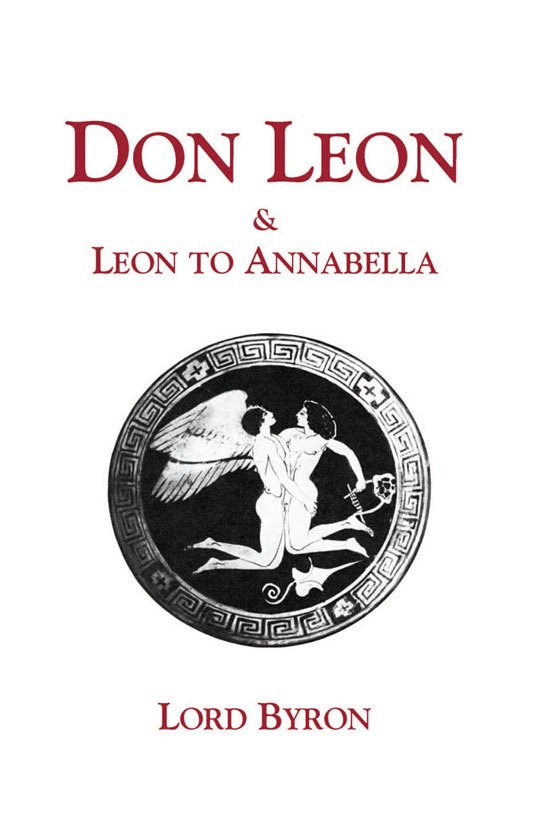
Lord Byron (allonym), Don Leon & Leon to Annabella, edited by John Lauritsen, Pagan Press 2017, ISBN 978-0-943742-21-2, 185 pages, $14.99. Smyth-sewn case binding. Printed on acid-free paper. Publication date: 1 July 2017.
Written and published in the early 19th century, Don Leon is unique in English Literature. It is a powerful outcry against injustice, a moving and erudite defense of male love, and an account of Byron's sexuality, which on the whole has proven to be true.
Don Leon forcefully demands the repeal of Britain's sodomy (or “buggery”) statute, under which men and even adolescent boys were being hanged for having sex with each other. As a polemic for the emancipation of male love, Don Leon is not only far in advance of its time, but is far in advance of our own time. There is no suggestion of a minority psycho-sexual condition (“homosexuality”), nor that males who have sex with each other are different from other males. The love of male for male is treated as potentially part of all human males, not just a minority.
Among neglected literary masterpieces, Don Leon heads the list — not only neglected, but vilified and rigorously suppressed. It is great poetry — a gay epic. At the same time, it is undeniably pornographic. In 1934, when Fortune Press published Don Leon, together with its companion poem, Leon to Annabella, the edition was immediately confiscated by the London police, who burned all the copies they could find.
Although previous editions have shown “Lord Byron” as the author, he cannot be the sole author, since the poem refers to events after his death. The vexed question of authorship is discussed at length.
This edition reproduces gay historian Louis Crompton's long article, “Don Leon, Byron, and Homosexual Law Reform”, in which he discusses the history of the poem and analyzes it in historic context.
This will be the definitive edition of Don Leon. In preparing it, editor John Lauritsen spent days in New York City's Morgan Library, which has the unique surviving first edition copy of Leon to Annabella and the oldest surviving edition of Don Leon (Dugdale 1866). Both poems, and especially the notes, contain many passages, some of them long, in foreign languages: Latin, Greek, French, German, and Italian. This is the first and only edition to translate them into English.
This book is of great value to gay historians and students of Romanticism. It can be read for pleasure by anyone who loves poetry.
• To read a review by Alan Contreras in Gay & Lesbian Review click here.
• To read a review by Professor William A. Percy click here.
• To read a review by Caroline McCullagh (Mensa Bulletin) click here.
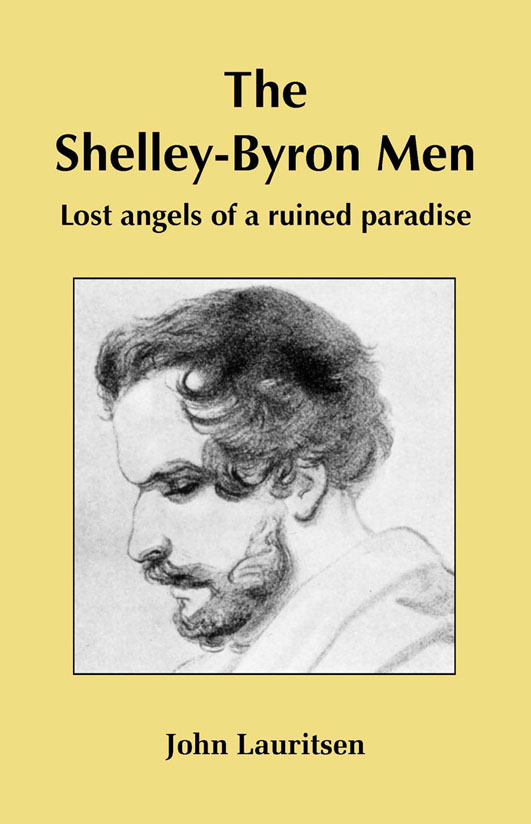
John Lauritsen, The Shelley-Byron Men: Lost angels of a ruined paradise, Pagan Press 2017, 192 pages, ISBN 978-0-943742-30-4, $16. Printed case binding, Smyth-sewn. Publication date: 1 May 2017.
In this book, gay historian John Lauritsen tells a story that will not be found in standard biographies. In 1822, two great poets — Percy Bysshe Shelley and George Gordon, Lord Byron — lived in Pisa, Italy, together with three friends. They met daily in Byron's palazzo.
Although these men had wives and children, male love was an important part of their lives. They thought of themselves as “pariahs” in “exile”, and for good reason. Men and boys in their home country, England, were being hanged for having sex with each other, whereas Italy had no such laws.
All of them were ardent Hellenists, who knew that male love had flourished in Ancient Greece — the same male love that was persecuted in their own time.
Despite the censorious efforts of friends and family, ample evidence survives that they loved other males. Homoeroticism in their works was usually coded for the “initiated”, but was sometimes amazingly candid.
John Lauritsen de-codes homoerotic references, reinterprets major works of English Romanticism, and places all in historical context. He states: “Love and sex between males is an ordinary, healthy part of the human sexual repertoire. For too long, biographers have falsified the love lives of the Shelley-Byron men. The time has come to bring them into the light of day.”
• To read a review by Jesse Monteagudo click here.
• To read a review by Caroline McCullagh in Mensa Bulletin click here.
• To read a review by "CrabbyPatty" (Gay Books Review) click here.
• To read a review by Kevin Jones (Amazon) click here.
• To read a review by James J. O'Meara (Counter-Currents) click here.

A Freethinker in Alcoholics Anonymous.
By John Lauritsen. 120 pages Illustrations, bibliography, and appendices. ISBN 978-0-943742-23-6. Trade paperback $12. Pagan Press 2014. Also available as a Kindle book on Amazon for $4.99 .
A Freethinker in Alcoholics Anonymous is written by an A.A. member with 46 years of continuous sobriety, who believes that he owes his life to the A.A. Fellowship.
There are plenty of books that attack Alcoholics Anonymous — or defend it uncritically — or supplement it with personal testimonies or various tweaks. A Freethinker in Alcoholics Anonymous will be the first one to celebrate and defend the things in A.A. that are right, but also, with no holds barred, to criticize the things that are wrong and ought to be changed.
An atheist for all of his adult life and a long-time contributor to the secular humanist press, Lauritsen bases his recovery on the what he calls the True A.A., the A.A, that works: the 24-Hour Plan and the Fellowship. He regards the religiosity in A.A. as detrimental to recovery from alcoholism.
A Freethinker in Alcoholics Anonymous is especially written for nonbelievers in recovery, who face difficult choices: going it alone or attending regular A.A. groups, secular A.A. groups, or secular alternative groups. But everyone who has an alcohol problem, or who knows someone who has one, can benefit from this book.
Chapters describe Lauritsen's experiences in recovery, his analyses of the 24-Hour Plan and the A.A. Fellowship, his research on early A.A. history and forerunners of A.A., his objections to recitation of the “Lord's Prayer” in meetings, “A Freethinker's Steps for Recovery from Alcoholism”, a heavily annotated Select Bibliography on Alcoholism, suggestions on how freethinkers can gain fellowship without sacrificing their principles, and his conclusions on how A.A. should be reformed.
For Thomas B.'s review in AA Agnostica click here.
For Caroline McCullagh's Page Turners review in Mensa Bulletin click here.
For Joe C.'s review in Rebellion Dogs Publishing click here.
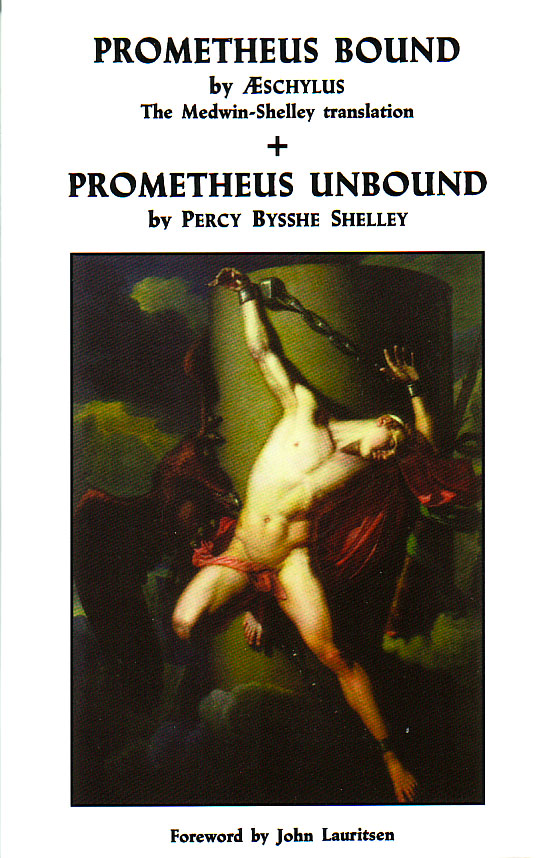
Prometheus Bound by Aeschylus, translated by Thomas Medwin & Percy Bysshe Shelley + Prometheus Unbound by Percy Bysshe Shelley. Edited and with Foreword by John Lauritsen. 211 pages. Trade paperback. $16 ISBN 978-0-943742-19-9. Pagan Press 2011.
This book contains two major works. The first is the Aeschylus play, Prometheus Bound, masterfully translated by Percy Bysshe Shelley and his cousin, Thomas Medwin. The second is Shelley's own poem, Prometheus Unbound, which is considered his masterpiece. This book also includes an appreciation of Prometheus Unbound by John Addington Symonds, and the poem Prometheus, by Johann Wolfgang von Goethe, newly translated from the German.
Editor John Lauritsen demonstrates, through biographical and textual evidence, that Shelley was the chief author of the Prometheus translation, which is a masterpiece in its own right. Shelley worked on it for years, engrossed by the theme of rebellion against tyranny — dominant in the Aeschylus play and the poems by Goethe and himself.
Comparisons between the Medwin-Shelley translation of Prometheus Bound and Shelley's own Prometheus Unbound show Shelley's amazing versatility at versification; he was the master of more verse forms than any other poet in English. Above all, they display Shelley's gift for dialogue, which he elsewhere demonstrated in his translations from Plato and Goethe; his play, The Cenci; and his novels.
The unjustly forgotten Medwin-Shelley translation is still unequalled for dramatic power and poetry. It is one of the few translations that could effectively be put on the stage.
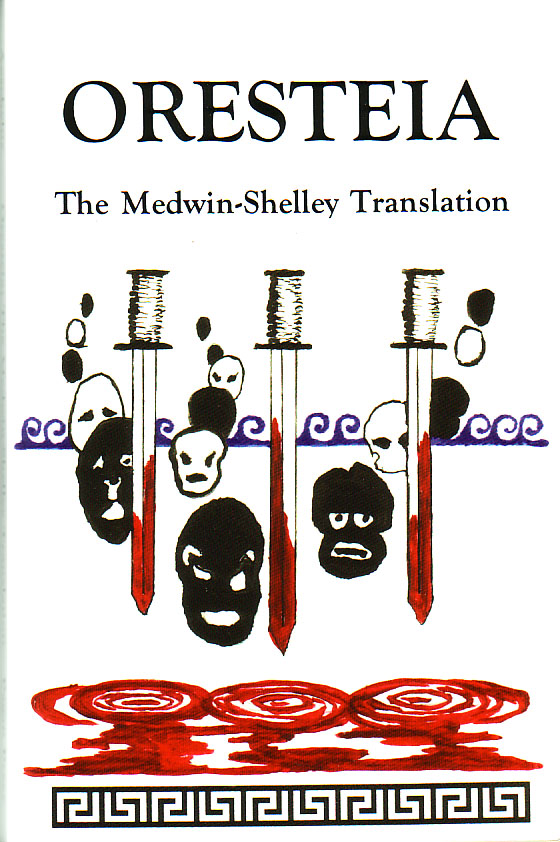

Oresteia: The Medwin-Shelley Translation. Aeschylus, translated by Percy Bysshe Shelley & Thomas Medwin. Edited and with Foreword by John Lauritsen. 192 pages. Trade paperback. $14 ISBN 978-0-943742-16-8. Pagan Press 2011. Also available as a Kindle book on Amazon for $3.99 .
The Aeschylus plays that make up the Oresteia trilogy — Agamemnon, Choëphori (Libation Bearers), and Eumenides (the Kindly Ones) — are among the supreme masterpieces of world literature. This book is the first publication for over 170 years of a forgotten masterpiece of translation, done by Percy Bysshe Shelley, one of our greatest poets, and his friend and cousin, Thomas Medwin.
When published separately in the 1830s, under Medwin's byline, the translations were critically acclaimed as “by far the best” into English, having “fire, spirit, and general correctness.” But they were not reprinted, and are now known to few, if any, students of English literature.
Editor John Lauritsen demonstrates, through both biographical and textual evidence, that Shelley must be acknowledged as a full collaborator in the Oresteia translation. Shelley was an extraordinarily gifted translator, rivaled only, if at all, by Pope and Dryden. He was not concerned with slavishly literal, word-for-word translation, but with re-creating the full and entire sense — the energy, wit, irony and pathos — of the original. Shelley was the master of more verse forms than any other poet in English: this translation contains intricate verse forms of his own devising, as well as traditional sonnets, Spenserian stanzas, and odes.
Shelley's hand is as unmistakable in the dialogue as in the verse passages, for he was a master of dialogue, as shown in his translations from Plato and Goethe, his plays, novels, and verse dramas. While maintaining an Aeschylean formality, the language is idiomatic, and the lines can effectively be spoken. Given actors and an audience accustomed to Shakespeare, Oresteia: The Medwin-Shelley Translation could successfully be put on the stage.
The Medwin-Shelley translation is still unequalled for dramatic power and poetry.
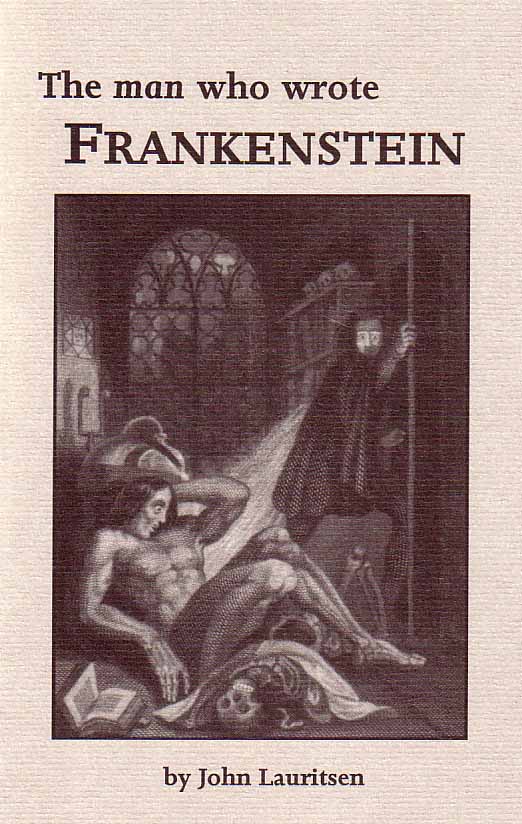
The Man Who Wrote Frankenstein.
By John Lauritsen. 232 pages. Illustrations, bibliography, and appendices. Trade Paperback: Price lowered to $3.99 (was $16.95) ISBN 978-0-943742-14-4. Also available in a Library Binding (Smythe sewn, case binding): $24.95 ISBN 978-0-943742-15-1. Pagan Press 2007.
Frankenstein is the most famous work of English Romanticism. Victor Frankenstein and the monster he created have entered our collective imagination — through movies, comic books, T-shirts, Halloween masks, etc. They have entered the discourse of erudite scholars, as well as the man on the street.
The conventional belief is that Frankenstein was written by a teenaged girl, Mary Godwin (later Mary Shelley), who took part in a ghost-story contest in Geneva, had a nightmare, and was inspired to write a story “which would frighten my reader as I myself had been frightened that night!”
John Lauritsen's new book, The Man Who Wrote Frankenstein, explodes the Mary Shelley myth, demonstrating that Frankenstein is not just a scary story, but a work of profound and radical ideas, written by one of the greatest poets in English, who deliberately concealed his authorship. The book has three theses:
•
Frankenstein
is a great work, which has consistently been underrated
and misinterpreted.
•The real author of Frankenstein is Percy Bysshe Shelley.
• Male love is a central theme of Frankenstein.
•The real author of Frankenstein is Percy Bysshe Shelley.
• Male love is a central theme of Frankenstein.
According to Lauritsen, male love, as romantic friendship, is a central theme of Frankenstein. Sometimes the expressions of male love are remarkably direct, but at other times they are expressed in coded language or references known only to the “initiated”. He uses his skills as a gay historian to decode and interpret these references.
The Man Who Wrote Frankenstein has nine appendices, which include full texts of the following:
• Percy Bysshe Shelley's Preface to Frankenstein.
• Shelley's review of Frankenstein.
• The Introduction to the bowdlerized 1831 edition of Frankenstein — which was written, at least in part, by William Godwin.
• The 1824 Knights Quarterly review of Valperga.
• Richard Garnett's essay on Mary Shelley from the Dictionary of National Biography.
There is also an annotated Bibliography.
For Camille Paglia's Salon.com review click here.
For Jim Herrick's review in Gay Humanist Quarterly click here.
For Richard Labonte's “Bookmarks” review click here.
For Tom Elliott's Mensa Bulletin review click here.
For Jesse Monteagudo's review in the South Florida Express click here.
For Hubert Kennedy's review in The Guide click here.
For Ian Young's review in Torso click here.
For Andrew Calimach's review click here.
For Douglas Sadownick's review in Gay & Lesbian Review click here.
To visit The Frankenstein Pages, devoted to illustrations and essays on Frankenstein, click here.
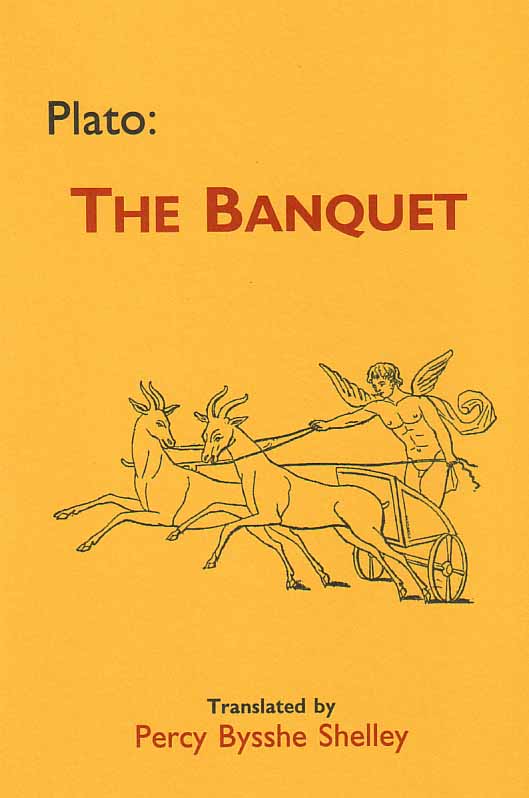
The Banquet. By Plato, translated by Percy Bysshe Shelley. 96 pages. $8 Trade Paperback. ISBN 0-943742-12-9. Pagan Press 2001.
Witty, sexy and radiantly beautiful, the Shelley translation of Plato's great Dialogue on Eros, The Banquet (or The Symposium) is by far the best in English. It has been described as conveying “much of the vivid life, the grace of movement, and the luminous beauty of Plato” — “the poetry of a philosopher rendered by the prose of a poet”.
Although a masterpiece in its own right, the translation was suppressed and then bowdlerized for well over a century. In 19th century England, male love — at the heart of the dialogue — was unmentionable. The Banquet and Shelley's accompanying essay, “A Discourse on the Manners of the Antient Greeks”, were not published in their entirely until 1931, and then in an edition of 100 copies intended “for private circulation only”.
For many years, the Shelley translation has been unobtainable, new or used. Pagan Press now offers a new edition, which is complete and authentic. It is the most readable edition even published.
For William A. Percy's review in the Gay & Lesbian Review click here.
For Richard Dey's review, “The Naked Classical Model”, click here.
For Jim Herrick's review in New Humanist click here.

A Freethinker's Primer of Male Love.
By John Lauritsen. 96 pages. $6.95. Trade Paperback. ISBN 0-943742-11-0 Pagan Press 1998.
The main essay in this book, “A Freethinker's Primer of Male Love”, is a celebration and defence of male love from a secular humanist perspective. Its leading thesis: Male love is good; the opprobrium suffered by gay men is a product of Judeo-Christian superstition.
A companion essay, “Paradigms For Gay Liberation”, recounts the ideas that have informed the movement. The author analyzes how the present-day movement has lost its bearings, and he indicates a way out of the thicket.
There are eight Excursus: Male Beauty, The Golden Legend, Gay Christian Revisionism, Pluralistic Ignorance, Freethought, Circumcision of the Spirit, The Aster Epigrams of Plato, and A Pagan Prayer. An annotated Bibliography provides guidance for further reading.
For Jack Nichols' review in Gay Today click here.
For William A. Percy's review in Journal of Homosexuality click here.
For Richard Dey's review, “The Naked Classical Model”, click here.
For Ian Young's review in Torso click here.

The AIDS Cult: Essays on the gay health crisis. Edited by John Lauritsen * Ian Young. 224 pages. Photographs and appendices. Price lowered to $4.99 (was $15). Trade Paperback. ISBN 0-943742-10-2 Asklepios 1997.
Published in February 1997 under the Asklepios imprint (for health-related books), this is the first book to deal comprehensively with the real reasons gay men are becoming sick in ways that are called “AIDS”.
The editors, John Lauritsen and Ian Young, and the other six contributors to The AIDS Cult, examine psychological and cultural issues — the ways religious intolerance, group fantasies, toxic drugs, pharmaceutical propaganda, deadly counselling, and a Cult of Doom have acted together to destroy the health of gay men. In his Introduction Ian Young writes: “The orthodox view of our protracted health crisis — as a highly infectious contagion from without — has been found wanting.... We must seek the causes of this and other medical dilemmas in our own society, our own assumptions, our group-fantasies, our regimens, our recreations, and our rituals.”
For Mark K. Anderson's review in the Valley Advocate click here.
For Elizabeth Ely's review in Townsend Letter for Doctors & Patients click here.
For Alex Russell's review in Continuum Magazine click here.
For Henry H. Bauer's review in Journal of Scientific Exploration click here.
Rex Poindexter's review in 4Front has been deleted. For an explanation click here.

The AIDS War: Propaganda, Profiteering and Genocide from the Medical-Industrial Complex. By John Lauritsen. 480 pages. Photographs, graphs, and other illustrations. Name and subject indices. $20 Trade Paperback. ISBN 0-943742-08-0 Asklepios 1993.
The AIDS War is a collection of John Lauritsen's major writings on AIDS, going back to February 1985. Book and author have been featured on Tony Brown's Journal, radio talk shows, and American, Canadian, British, Australian and German television.
There are 35 chapters, including:
• The first interview with molecular biologist Peter Duesberg.
• “Latex Lunacy” (latex gloves, condoms, etc.).
• “Poppers: The End of an Era” — a history of the premier gay drug (nitrite inhalants).
• “The Risk-AIDS Hypothesis” — the real reasons gay men, intravenous drug users, and others are getting sick.
• A comprehensive program of recovery for those with a diagnosis of “AIDS”.
• “The AIDS War: Lies and Censorship in AIDS Coverage”.
• “FDA Documents Show Fraud in AZT Trials”.
• “AIDS Criticism in Europe”.
• “The Incidence Quagmire”.
• “AIDS Organizations” — the real story.
• “The Death of Rudolf Nureyev” — from AZT poisoning.
For Mike Chapelle's review in Bloomsbury Review click here.
For Christopher DeCenzo's review in the Cornell Review click here.
For Jule Klotter's review in the Townsend Letter for Doctors click here.
For Henry H. Bauer's review in Virginia Scholar click here.
For Jerry Terranova's review in Praxis click here.
OUT-OF-PRINT:
The following titles are out-of-print: Ioläus by Edward Carpenter; Male Love: A Problem in Greek Ethics and Other Writings by John Addington Symonds; Death Rush: Poppers & AIDS by John Lauritsen; Poison By Prescription: The AZT Story by John Lauritsen. (The last two books are available online: just click on the titles.)
ORDERING:
Books can be ordered directly from Pagan Press using PayPal. Just send an e-mail to Pagan Press mentioning the books you wish to buy. We will then send you back an e-mail invoice, which will give the total cost, including shipping and handling. If you wish to purchase the books, click the Pay button on the invoice — which takes you to the secure PayPal site, where you can pay through your PayPal account (if you have one) or through a credit card.
For United States orders postage is free. For overseas air mail, postage will be calculated at cost. If you use PayPal, you will make payment in your home currency.
Pagan Press books can also be purchased from Amazon.com.